
Self-contained, self-charging electric pump system for XOD
What becomes readily apparent after a very short time sailing XODs, is that the ability to pump out water is a critical safety and performance factor when racing. The volume of water that can enter the boat in a lumpy sea, particularly in a wind against tide situation, is truly impressive.
Having limped through 2024 season with a jury-rigged, bodged-together system for an electric pump, I decided to upgrade to something more suited to purpose in 2025.
My list of criteria for this system was as follows:
- Must be reliable
- Should be self-powered and self-contained
- Should have capability of manual or automatic pumping, or “off”
- Should be lightweight, minimal and not interfere with racing
- Switch should be accessible when racing to switch on-off
With this in mind, here is an overview and tour of the system that I’ve installed.
Solar panel:
in 2024, I had a cheap no-name solar panel onboard which behaved well through the last race of the season. However, the junction box was glued onto top of panel, and had some sharp edges which eventually caught the mainsheet, destroying the panel midway thru last race of 2024. Lesson learned: avoid panels with sharp edges or pieces that can be ripped off. In 2025 I’ve opted for a Lensun Solar 20W panel that has a small rounded bulb with the cables exiting as one. This, positioned aft near the transom has been much better this season.
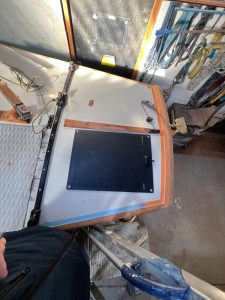
this is available from Amazon here.
Battery:
The next key component of this system is the battery. Given my criteria to keep things lightweight, I opted for a Lifepo4 lithium battery. These are now quite well proven technology, and that particular chemistry is quite safe compared with some earlier lithium ion battery chemistries.
A 12V nominal, 8Ah battery from Amazon is relatively inexpensive these days. While the model I’m using doesn’t seem to be available any longer, a very similar one is available here.
Why lithium?
- charge/discharge cycles mean it should last 3-4x a lead-acid battery.
- this size of battery weighs less than 1kg, about 1/3 of a similar-capacity AGM battery.
- lifepo4 batteries can be safely discharged to 10% capacity or so, meaning that you get 80-90% of the capacity as useable energy, whereas lead-acid batteries are something more like 40-50% useable capacity
For a given capacity, you get twice the capacity for about 1/3 the weight, and when you factor in longevity, they are usually cheaper as well.
NOTE: you should do your own research and decide for yourself if this risk of having a lithium battery onboard meets your own level of risk tolerance!
Solar charge controller:
in order to charge the battery, but also avoid overcharging it, a battery charge controller is an essential component of a system built to last. While there are cheap PWM charge controllers available, Victron is the gold-standard for renewable energy electronics. I’ve opted for a Victron 75/10 (75 volts max solar voltage, 10 Amps max charging current), more than enough for a single 20W solar panel.
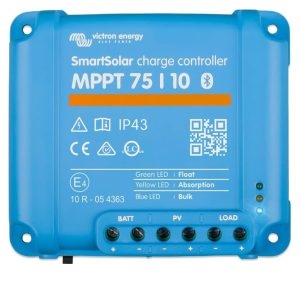
This little unit sits between battery, solar panel, and pump. Its main function is to stop charging the battery once fully charged voltage has been reached. However, it also has a few other new features. It allows Bluetooth connection to a phone, so you can check the state of charge remotely without having to open anything up. Also, it provides a convenient way to connect the pump (via the load terminal). Because the pump is connected thru the charge controller, it can also show how much current is being drawn while pumping (about 1.5 amps in my case).
Pump:
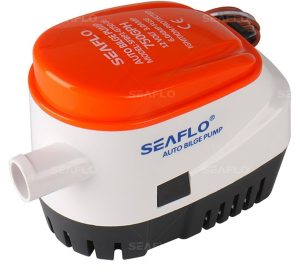
I have been using an inexpensive Seaflo pump from Amazon. I can’t particularly recommend it as I’ve burned one out already (with no apparent cause) and have replaced it with a spare of the same. For reference, this is what I’m using. However, I would recommend splurging for a better pump from Rule or Sahara, as I will be doing once this one also burns out.
Housing:
One of the challenges of fitting this equipment on an XOD is where to put it, and in what? I decided I wanted a semi-permanent home for this equipment as assuming I’ve wired things properly, it should be relatively low-touch and low-maintenance. In the end, I opted for a garden elctrical enclosure box with a snap-on lid, and mounted that to the aft side of the aft cockpit bulkhead. Here’s what it looks like in place:
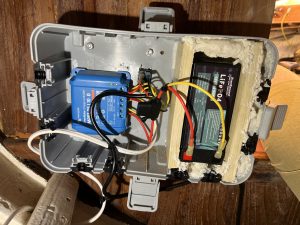
the battery compartment on the right was bodged together with a mixture of some rigid foam, and some foam spray sealant. I’m sure many of you could do a more elegant job of this, but this is functional and hidden away behind the case cover. I may experiment in future with 3d printing a custom housing which could be smaller, and fit the various parts exactly.
With the cover installed, this is what it looks like:
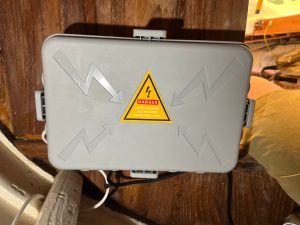
The housing was purchased on Amazon, here.
Switch:
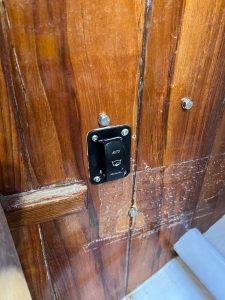
My bilge pump switch sits on the other side of the bulkhead, and I cut a small hole through the bulkhead and the housing box so that all the wiring will remain more or less dry inside the housing. The switch was sealed with liberal amounts of sika-flex around the mounting hole. It looks like this:
Why install a switch at all?
One of my frustrations with pump setup in 2024 is that one Saturday, I arrived on the boat to a dead battery and pump float stuck “on”. I worry about a wooden boat being unattended for long periods of time, with the possibility of a pump stuck “on” potentially overheating and causing a fire. This worry has led me to leave the pump off during the week and allow small amount of fresh rainwater to accumulate in the bilge. This is quickly pumped out when I arrive to the boat and reduces any worry of overheating or dead batteries before racing. The switch has 3 settings, automatic manual, and off. Automatic is the default when sailing in lumpy conditions and generally you don’t think about it until race is done, water just goes overboard when the float activates. Manual setting is handy before racing to get the bilge as dry as possible and will allow smaller amounts to be pumped out than would activate the float on the pump. When leaving the boat on the mooring for a few days, i typically switch the pump off.
The switch I’m using is available here from Amazon.
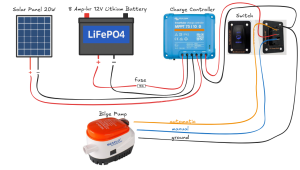
Wiring Diagram:
Here’s how the system is connected together.
Final thoughts:
- I inherited my boat setup to have bilge pump send its output through the manual pump on starboard deck. I don’t love this arrangement and am considering a dedicate smaller line to the transom for electric pump exhaust
- The position of the electric pump in a shallow sump on the centreline means that when heeled over, an enormous amount of water needs to be in the boat before the float is triggered. There is probably a better way, but for now, sailing the boat more upright helps the pump.
- Most pumps don’t have long enough power leads to go from in front of mainsheet post back to behind after bulkhead. I’ve opted for a join to some high quality Ancor marine-grade electric cable, but I would still prefer no join at all. Ideas?
- My 750 gallon per hour rated “cheap” pump is more than fast enough. My worry about going to a more powerful one would be higher current , higher wire temps, etc. I might even consider downgrading to a higher quality 500 gallon per hour model in order to keep current as low as possible and no raised temps in the wire when pumping for extended periods.
- Strings or any bits of fibre are the sworn enemy of pumps. They slip thru a strainer easily and will clog / burn out a pump in no time. I’ve now taken to being extremely fastidious in removing all bits of string from any rope work onboard, and regularly checking the bilge / pump strainer for anything likely to clog.
Hope this was useful.
Feel free to share your thoughts / comments with me at: madcap (at) norrismail.net
Happy XODing!
Shaun Norris
June 9, 2025